What triggers altseason?

When people ask "What triggers altseason?", they're usually trying to understand which specific conditions need to align for capital to rotate from Bitcoin into altcoins, creating the explosive rallies that make altcoins outperform BTC.
There's no single trigger. Altseason emerges when multiple signals align: Bitcoin reaching new highs and consolidating, dominance falling below critical levels, halving cycles creating timing windows, on-chain indicators showing rotation pressure, and macro conditions supporting risk-on behavior.
This article covers:
- Bitcoin peak and consolidation signals
- Bitcoin dominance critical levels
- Capital flow and narrative shifts
- Halving cycle timing
- On-chain indicators that confirm rotation
- Macro and liquidity factors that can delay or accelerate altseason
Bitcoin peak and consolidation
Altseason typically doesn't start while Bitcoin is in a strong uptrend. Instead, it emerges when Bitcoin has reached a significant high and begins consolidating. This creates a psychological shift where investors feel Bitcoin has "done its job" and start seeking the next opportunity.
The pattern:
After Bitcoin reaches new all-time highs or approaches major price milestones (like $100k or higher), it often enters a consolidation phase. During this period, Bitcoin's price stabilizes or moves sideways, while altcoins begin to show relative strength. This happens because:
- Investors who've profited from Bitcoin's run start taking profits
- Capital that was waiting for Bitcoin to "prove itself" now feels confident to rotate
- The narrative shifts from "Bitcoin only" to "what's next?"
Historical examples show this clearly. In 2017, Bitcoin peaked near $20,000 in December, then consolidated through early 2018 while altcoins exploded. In 2021, Bitcoin reached $69,000 in November, then entered a consolidation phase that allowed altcoins to outperform through the first half of 2021. Understanding when altseason will start requires recognizing these consolidation patterns early.
The key is recognizing when Bitcoin's momentum is slowing and consolidation is beginning, rather than waiting for a sharp correction. Early detection here gives you time to position before the broader altseason accelerates.
Bitcoin dominance critical levels
Bitcoin dominance measures Bitcoin's share of total crypto market capitalization. When dominance falls below certain critical levels, it signals that altcoins are collectively gaining market share and rotation is accelerating.
Critical dominance thresholds:
- Below 60%: Early rotation signal. Capital is starting to flow from Bitcoin to altcoins, but rotation is still in its early stages.
- Below 50%: Strong altseason signal. This level suggests significant capital rotation is underway, with altcoins collectively gaining substantial market share.
- Below 40%: Extreme altseason. This level indicates massive rotation, often seen during the most explosive altseason phases. During the 2021 altseason, Bitcoin dominance fell to as low as 39% in May 2021, representing one of the most extreme capital rotations in crypto history, as altcoins collectively gained market share while Bitcoin consolidated near its peak.
These levels aren't magic numbers, but they provide useful benchmarks. When dominance breaks below 60%, it's worth paying attention. When it breaks below 50%, rotation is likely accelerating. When it approaches or breaks below 40%, you're in the heart of a strong altseason.
The rate of change matters too. A slow, gradual decline in dominance suggests steady rotation. A rapid drop suggests rotation is accelerating quickly, which can create explosive altcoin moves but also increases the risk of a sharp reversal.
Capital flow and narrative shifts
Altseason isn't just about technical metrics. It's also driven by capital flow patterns and narrative shifts that capture investor imagination.
Search volume and social signals
When interest in altcoins spikes, it often signals that altseason momentum is building. This shows up in:
- Increased search volume for "altcoins" and specific projects on Google Trends
- Social media discussions shifting from Bitcoin to altcoin projects
- Meme coin rallies and speculative narratives gaining traction
- New project launches and token launches attracting attention
These aren't technical indicators, but they reflect the psychological shift that accompanies altseason. When retail starts talking about altcoins instead of just Bitcoin, rotation is often already underway.
Narrative cycles
Each altseason is driven by new narratives that capture investor imagination. The 2017–2018 altseason was dominated by ICOs and the idea that blockchain could disrupt any industry. The 2021 altseason was driven by DeFi, NFTs, and metaverse narratives, as explained in this analysis of what drives altcoin seasons.
Looking ahead, potential narratives for future altseasons might include:
- BRC-20 tokens and Bitcoin-based DeFi, bringing financial applications to Bitcoin's network
- Real-world assets (RWA) tokenization, where traditional assets like real estate or commodities are represented on-chain
- AI tokens and projects that combine artificial intelligence with blockchain technology
- Layer-2 solutions and scaling technologies that make blockchain more practical for everyday use
When new narratives emerge and gain traction, they can accelerate rotation by creating excitement and attracting capital. The key is recognizing which narratives are gaining momentum and whether they have enough substance to sustain a broader altseason.
Halving cycles and timing
Altseasons have historically followed a pattern relative to Bitcoin halving events. Understanding this timing helps you recognize when conditions are most favorable for rotation.
The 6–9 month window
Looking at historical patterns, altseasons have typically emerged 6–9 months after Bitcoin halvings. This timing makes sense structurally:
- The halving creates Bitcoin scarcity pressure, driving BTC's price higher
- Once Bitcoin has made significant gains (typically 12–18 months post-halving), it begins consolidating
- This consolidation phase creates the window for capital rotation into altcoins
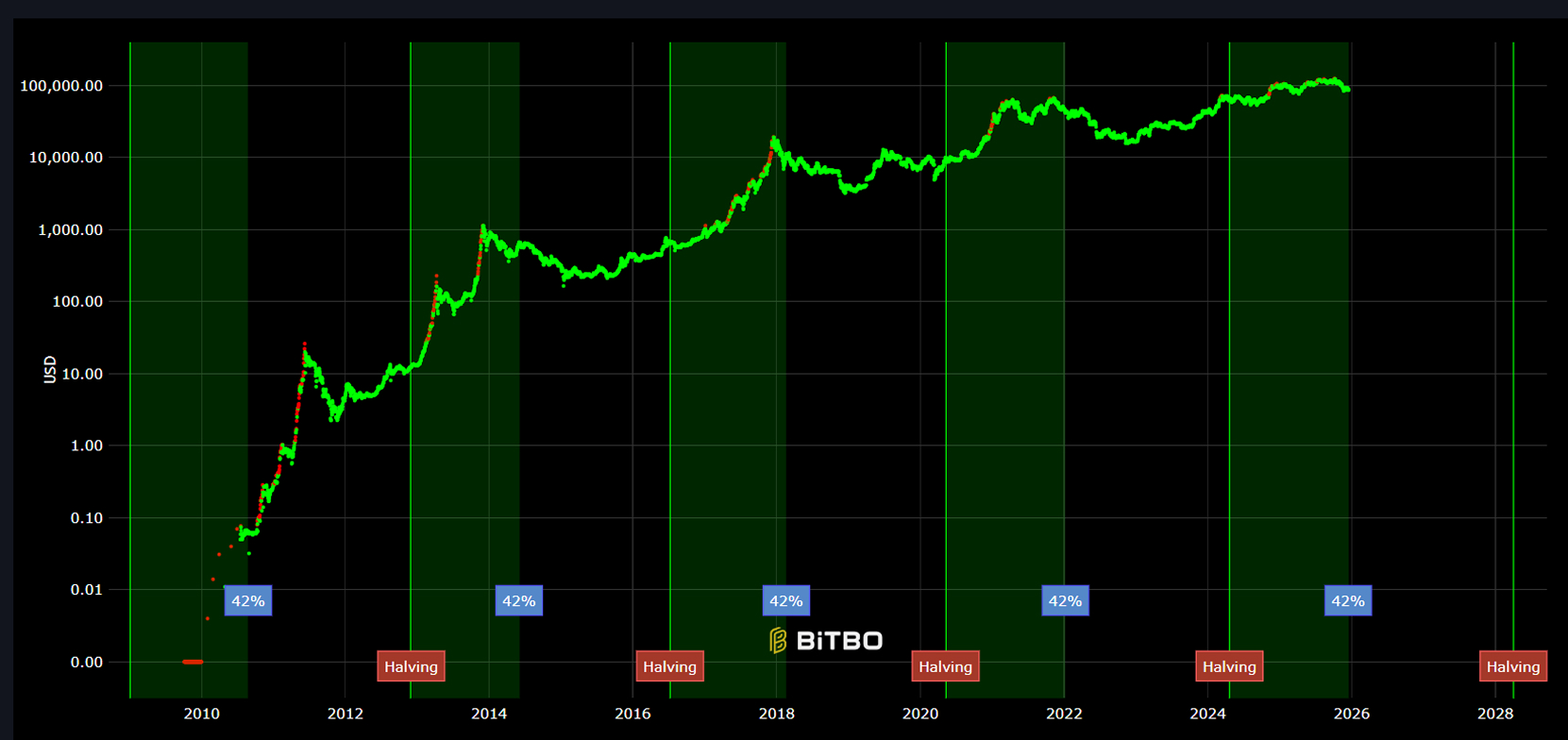
For example:
- 2016 halving (July 9, 2016) → Altseason emerged in early 2017, roughly 6–9 months later, with altcoins like Ethereum, Ripple, and Litecoin seeing massive gains
- 2020 halving (May 11, 2020) → Altseason emerged in early 2021, roughly 8–9 months later, driven by DeFi and NFT narratives
Current cycle timing
The most recent halving occurred in April 19, 2024. Following historical patterns, this would have put the altseason window somewhere between Q4 2024 and Q2 2025 (roughly 6–9 months post-halving).
However, as we approach the end of 2025, no altseason has occurred. This suggests that while halving cycles provide a structural framework, other factors can delay or modify the timing. The current cycle has been influenced by institutional adoption, ETF flows, and macro conditions that may have extended the BTC-led phase beyond historical averages.
This doesn't mean altseason won't happen. It suggests that the timing window may be wider than in previous cycles, or that specific triggers (like Bitcoin reaching new highs and consolidating) haven't yet aligned.
On-chain indicators
Several on-chain metrics can signal when altseason is beginning or active. These indicators provide quantitative confirmation of rotation that's already happening.
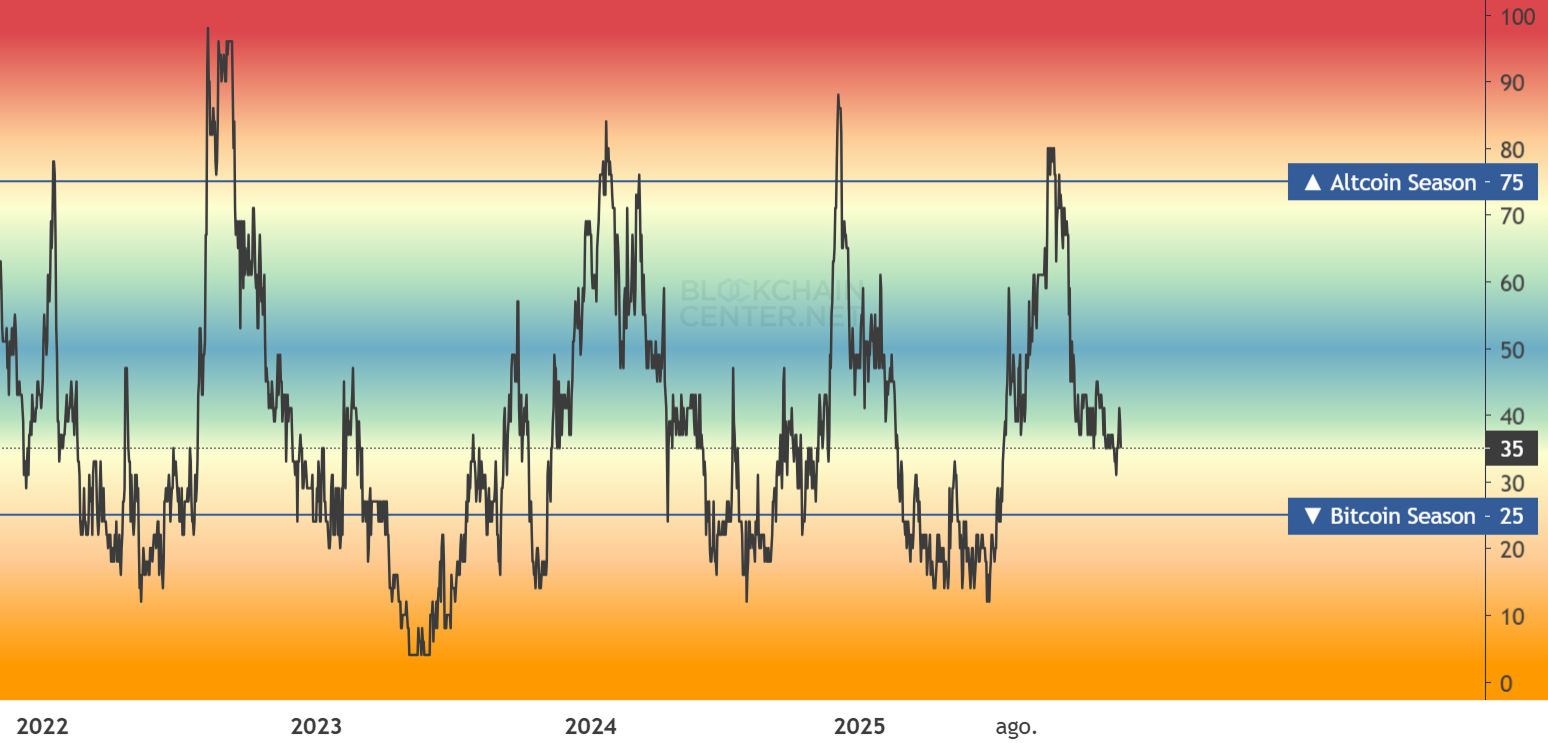
Altcoin Season Index above 75%
The Altcoin Season Index measures how many of the top 50 altcoins are outperforming Bitcoin over a 90-day window. When this index crosses above 75% and stays there, it confirms that altseason is active. This metric is part of the broader framework for understanding how altseason works, which involves tracking multiple rotation phases from Bitcoin-led markets to full altcoin rallies.
This is a lagging indicator. It confirms rotation that's already happened rather than predicting when it will begin. But it's useful for confirming that you're in an altseason rather than just a brief rotation.
Market breadth and capital flow
When capital starts flowing down the market cap ladder into smaller altcoins, it signals that altseason is broadening beyond just major altcoins like Ethereum and Solana. The total market capitalization of altcoins (excluding Bitcoin and Ethereum) reaching new all-time highs provides a macro view of capital rotation, showing that rotation is the dominant dynamic rather than just overall market growth.
Macro and liquidity factors
Altseason timing and intensity aren't just about technical indicators or halving cycles. Macro-economic conditions and liquidity factors can significantly accelerate, delay, or modify the rotation cycle.
Monetary policy and liquidity
When the Federal Reserve cuts rates and injects liquidity into the system, risk appetite increases, supporting altcoin speculation. Abundant liquidity makes investors more willing to take risks, which benefits altcoins more than Bitcoin due to their higher volatility and potential for asymmetric returns.
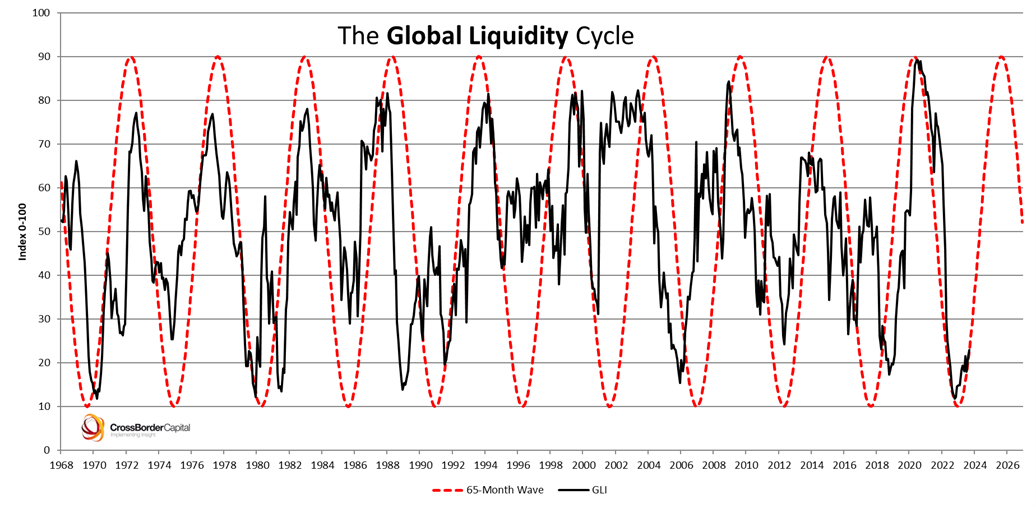
Conversely, monetary tightening can compress or delay altseason by reducing available capital and increasing the opportunity cost of holding non-yielding assets. When interest rates are high and liquidity is tight, investors prefer safer assets like Bitcoin or even traditional bonds over speculative altcoins.
Bitcoin ETF flows
The introduction of spot Bitcoin ETFs in 2024 created a new dynamic. Institutional capital flowing into Bitcoin ETFs can extend the BTC-led phase, delaying rotation into altcoins. This happens because:
- ETF flows create sustained buying pressure on Bitcoin
- Institutional investors often prefer Bitcoin over altcoins for regulatory and risk reasons
- Large ETF inflows can keep Bitcoin dominance elevated even as retail interest in altcoins builds
Conversely, when ETF flows slow or reverse, it can accelerate rotation as capital seeks higher returns elsewhere. The key is monitoring whether ETF flows are supporting Bitcoin dominance or whether they're starting to normalize, creating space for altcoin rotation.
Why altseason 2025 has been delayed
Some analysts argue that the current cycle's altseason has been delayed by a combination of factors:
- Monetary tightening: Higher interest rates and reduced liquidity have compressed risk appetite
- ETF flows: Sustained institutional capital flowing into Bitcoin ETFs has kept dominance elevated
- Lack of new narratives: Without compelling new use cases or technologies, capital hasn't had a strong reason to rotate from Bitcoin
This doesn't mean altseason won't happen. It suggests that the triggers haven't yet aligned. For altseason to emerge, you'd likely need:
- Bitcoin to reach new highs and consolidate
- ETF flows to normalize or slow
- Macro conditions to become more supportive (rate cuts, increased liquidity)
- New narratives to emerge that capture investor imagination
Combining signals for confirmation
No single indicator guarantees altseason. The key is recognizing when multiple signals align, creating a high-probability environment for rotation.
The combination approach
Instead of waiting for one perfect signal, monitor multiple indicators simultaneously: Bitcoin price action and consolidation, dominance falling below critical levels (60%, 50%, or 40%), ETH/BTC ratio momentum, market breadth showing more altcoins beating Bitcoin, halving timing (6–9 month window), on-chain metrics like the Altcoin Season Index, macro liquidity conditions, and narrative shifts.
When several of these signals align, the probability of altseason increases significantly. The more signals that align, the stronger the case for rotation.
The challenge of manual monitoring
The problem is that tracking all these signals manually is time-consuming and error-prone. You need to monitor Bitcoin dominance charts, ETH/BTC ratio movements, calculate market breadth, track halving timing, watch on-chain metrics, read macro conditions, and follow narrative shifts. This requires constant attention and the ability to synthesize multiple data points simultaneously.
Automated monitoring systems
This is where automated tools become valuable. Instead of manually tracking all these signals, you can use systems that monitor them automatically and alert you when conditions are aligning.
HunchMachine's API provides endpoints that track many of these signals automatically. The Altcoin Rotation Radar monitors Bitcoin dominance trends, ETH/BTC ratio momentum, and market breadth, then classifies the current market into rotation phases (BTC-led, ETH rotation, early altseason, full altseason).
The Altcoin Appetite Index measures market appetite for altcoins by blending liquidity flow, Bitcoin dominance trends, and capital rotation signals. The Rotation Momentum Index tracks how quickly capital is moving between Bitcoin, Ethereum, and altcoins.
Together, these endpoints provide a comprehensive view of rotation dynamics, helping you understand when multiple signals are aligning without needing to manually track each one.
For those who want to fully automate this monitoring, the Altcoin Opportunities Detector automation combines these indicators into a single workflow. It confirms the market is in a bull regime, detects when altseason is active via the Altcoin Rotation Radar, and identifies specific altcoin opportunities. This transforms rotation monitoring from a manual, time-consuming process into an automated system that alerts you when conditions change.
So… what triggers altseason?
Altseason is triggered by a combination of signals aligning: Bitcoin reaching new highs and consolidating, dominance falling below critical levels (60%, 50%, or 40%), halving cycles creating timing windows (typically 6–9 months post-halving), on-chain indicators showing rotation pressure (Altcoin Season Index above 75%, OTHERS index rising, altcoin market cap growing), and macro conditions supporting risk-on behavior.
But no single trigger guarantees altseason. The key is recognizing when multiple signals align, creating a high-probability environment for rotation.
The challenge is that tracking all these signals manually is difficult. You need to monitor Bitcoin price action, dominance trends, ETH/BTC momentum, market breadth, halving timing, on-chain metrics, macro conditions, and narrative shifts simultaneously. This requires constant attention and the ability to synthesize multiple data points.
Automated systems that monitor these signals and alert you when conditions are aligning can help. Instead of manually tracking charts and calculating metrics, you can use APIs that process the data automatically and return clear classifications of the current rotation phase.
The question "What triggers altseason?" stops being about memorizing a checklist and becomes: "How do I build a system that monitors multiple triggers simultaneously and alerts me when conditions are aligning for rotation?"
Monitor the signals, understand how they interact, and adjust your positioning as triggers align. Altseason doesn't start on schedule. It starts when the conditions that drive it align. Your job is to recognize those conditions as they form, not to predict them months in advance.